Lamp Size
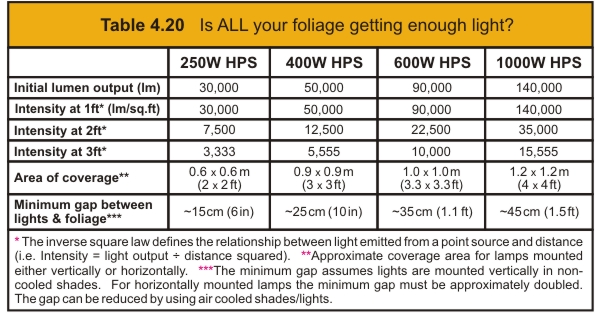
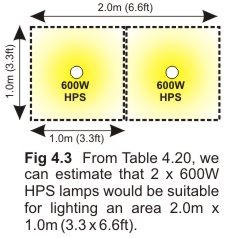
The input to a lamp is measured in watts (W). The size of the growing area will partly determine the required wattage - see Table 4.20 & Fig 4.3.
Plant Height
The height of a plant must be considered when determining lamp wattage. Light intensity diminishes rapidly as distance from the lamp increases (Table 4.20 shows the drop in intensity from 1ft to 3ft). For example, imagine your plants covered an area 0.9 x 0.9 m. You may be tempted to use a 400W HPS instead of a 600W HPS. The power costs are 50% less, and it generates less heat. However, if a significant proportion of the foliage is 3ft from the lamp, the intensity is only ~5,555 lm/sq.ft for that foliage. This intensity may be insufficient for the plant species being grown. By choosing a 600W HPS, the intensity would be roughly double - assuming the same size gap between the lamp and the foliage.

HINT: It is preferable to keep plants as short and wide as possible. This can be achieved by removing the ‘growing tip’. Also, erect netting at an appropriate height to restrain upwards growth and promote sideways growth.
Plant Density/ Shading
Shading becomes an issue when plants are positioned too close to one another. It is generally more productive to plant fewer plants, rather than more.

Lamp Height
Position the lamp as close as possible to the top of plants without causing photo-respiration or burning of foliage (see Table 4.20 for “minimum gap” guidelines). This best utilizes lamp output. Air cooled lights/shades should be used because they enable lamps to be positioned much closer to the foliage. These are particularly beneficial for 1,000W lamps (Fig 4.5).
Lamp Shades
These help maximize the amount of light being directed toward the plants (Fig 4.6). Shades need to be hung so that their height can be easily adjusted as the plants grow. For safety, ensure mounts are securely fastened to the ceiling. The use of reflective material on walls and other large surfaces helps ensure that light is not wasted through absorption.

Light cycles
Many plant processes optimally require a certain daylight duration. For example, some require ~18 hours of light per day during the seedling and vegetative phase. However, flowering is then induced by lowering the lighting duration to ~12 hours per day.
Be aware that growth can suffer if lighting intervals are irregular. Employ a timer to help ensure consistency. Note also, vital processes occur during the night (lights off) period so avoid interrupting it by turning lights on.